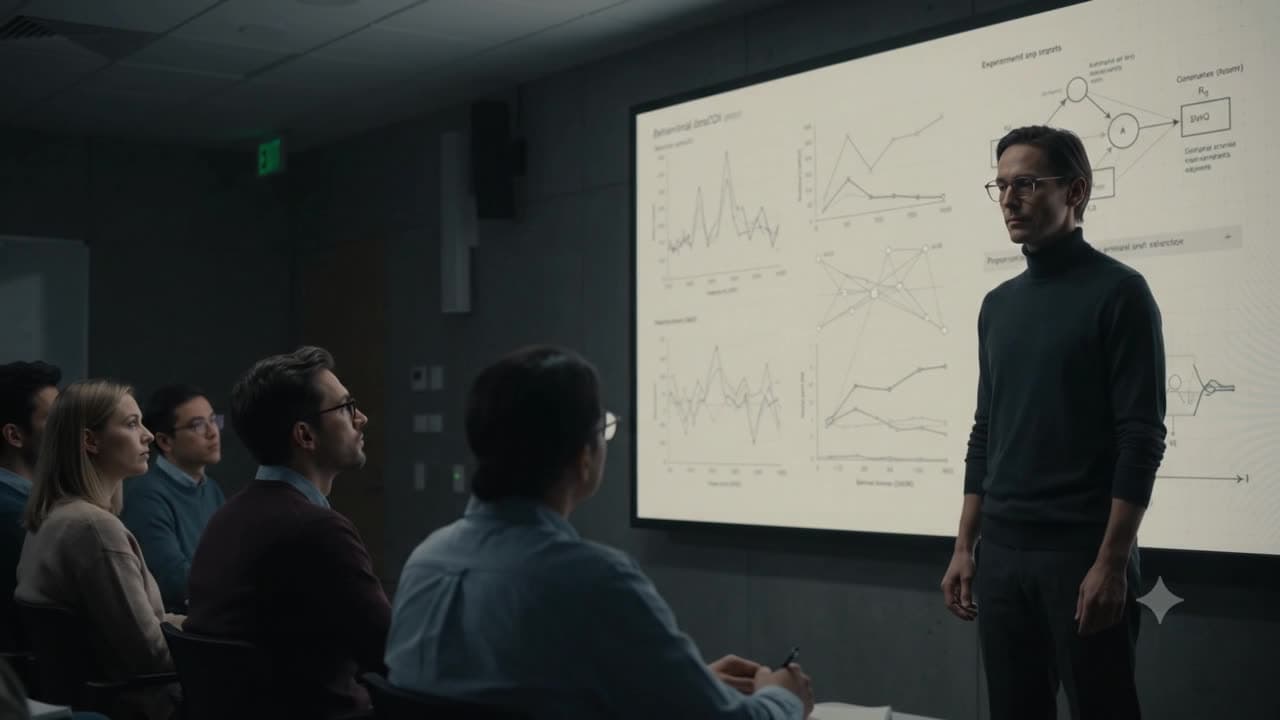
Controlled behavioral experiments
Simulation of fraudulent scenarios in a safe laboratory environment.
/01 - HUMAN
How people perceive risk, respond to pressure, and make financial decisions under manipulation - across cognitive security, victimology, protective technologies, and regulation.
PERCEPTION · PRESSURE · BIAS · DECISION · ACTION
/ PILLARS
/02 - HOW WE STUDY BEHAVIOR
Experimental simulation, measurement, modeling, and intervention design - scored by changes in action, not only awareness.
Simulation of fraudulent scenarios in a safe laboratory environment.
Games, simulators, and immersive scenarios for pressure-conditioned learning.
Measurement of attention and physiological response under manipulative stimuli.
MECE profiling, cluster models, and large-scale pattern monitoring.
Machine-learning approaches to victimization and vulnerability risk.
Inoculation protocols, checklists, and interface nudges tested against real behavior.
THE DECISION NETWORK
A live map of how a financial choice forms - from the first cue to the irreversible click.
/03 - CURRENT RESEARCH & TECHNOLOGY
Registered interactive training program for protection against financial fraud and social engineering.
Explore
Practice-oriented program for countering social engineering and financial fraud in the banking sector and for the public.
Explore
A systematized map of psychological mechanisms and vulnerabilities exploited by fraudsters, grounded in experiments and surveys.
Explore
Russian database of social-engineering incidents: depersonalized cases from partners for analysis, modeling, and experimentation.
Explore
Planned quarterly analytic product on population behavioral vulnerability.
Explore
Targeted content developed for the Bank of Russia Information Security Department: cluster analysis across 8 federal districts, 6 persona types, and differentiated strategies.
Explore
Interface elements and behavioral checklists designed for embedding into banking applications at moments of suspicious action.
Explore
/ EXPERIMENT
A short interactive simulation. Experience a financial social-engineering attack in two steps - and see how FTLAB breaks down the manipulation behind it.
SAFE SIMULATION
No personal data is requested, stored or transmitted.
/04 - FROM RESEARCH TO IMPACT
A working loop from observation to implementation in financial environments.
Human behavior under financial and social-engineering pressure.
Experiments, neurophysiological signals, and incident data.
Vulnerability mechanisms, victim clusters, and predictive risk.
Interventions, trainers, nudges, and protective protocols.
Behavioral-change metrics - action, not only knowledge.
Financial institutions, regulators, and educational systems.
/05 - FROM RESEARCH TO EDUCATION
Master’s programs, professional courses, and training formats that move laboratory methods into classrooms and financial organizations.
Master’s program; described as a Bank of Russia pilot project with banking and industry collaborators.
Master’s program developed with regulatory and industry collaborators named in laboratory materials.
Additional professional education track.
Online course for first-year students: cyber threats, personal data, social networks, deepfakes, practical defense skills.
All first-year students
Online course on financial literacy, banking, credit, insurance, digital payments, and case analysis.
Year 1–2 students
Practice program on countering social engineering, delivered with banking association and Bank of Russia structures.
/06 - RESEARCH OUTPUT
/07 - FIELD NOTES
2026-10-09 · Conference
Archived — 9–10 October 2026 in Petrovsky Hall: plenaries, platform and antifraud panels, Youth Day with masterclasses and the Golden Detector. Full program kept on site.
Read note →
2026-10-10 · Contest
Short videos on nudging and fraud protection — entries, criteria, and the full archive are published.
Read note →
2025-12-17 · Registered technology
Software certificate 2025696334 records the interactive simulator for financial-fraud and social-engineering defense. Full deployment is planned for October 2026.
2025-09-05 · Research forum
Scientific-event support for the round table on social-engineering counterpractice in banking (through 2026).